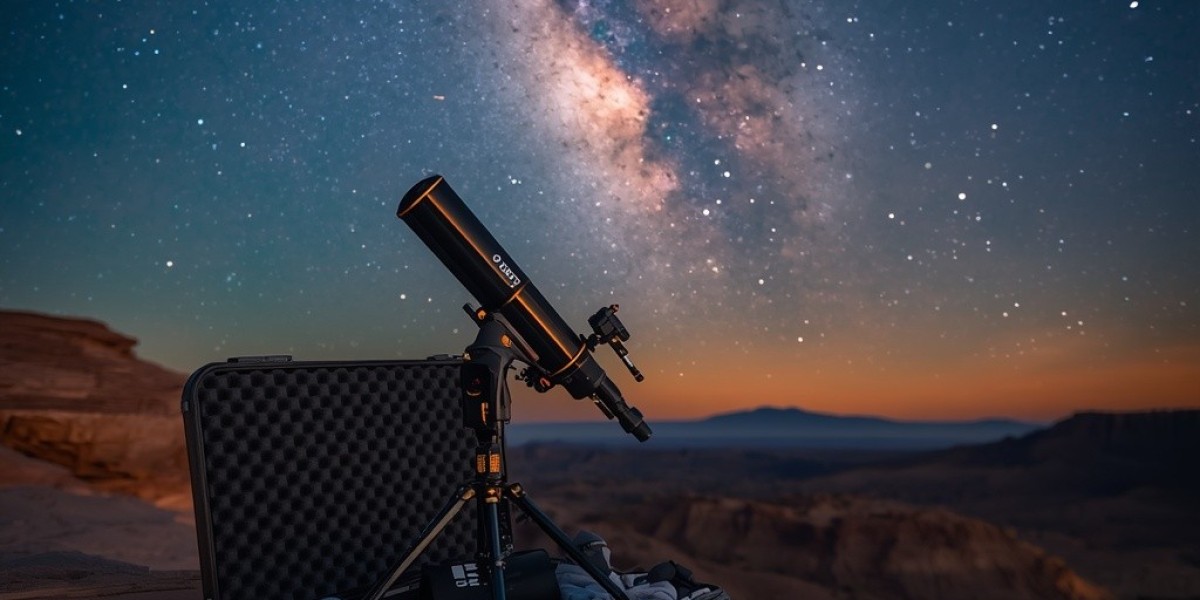

There's a quiet truth most beginners don't hear until after they've already bought their first telescope: the mount underneath it matters just as much as the glass on top. A gorgeous optical tube on a shaky, imprecise mount produces blurry, drifting images no matter how good the lens is. iOptron built its entire product line around solving exactly this, engineering compact, precise mounts and optical tubes that don't force you to choose between portability and performance.
If you're buying from Pakistan, here's a detail worth knowing upfront. Sky Deep is the only authorized dealer for the full iOptron collection anywhere in the country. Given how much precision engineering goes into these mounts, that fact carries real weight, and we'll explain exactly why further into this guide. First, let's go through what's actually available.
A Different Approach to Balancing Weight
Most equatorial mounts hang their payload off to one side of the mount head, which works fine but adds bulk for a given carrying capacity. iOptron's center-balanced design takes a different route, distributing weight more evenly around the mount's core. The practical result tends to be a lighter, more compact setup capable of carrying a similar payload to bulkier traditional designs.
Two Mounts, Two Very Different Imaging Ambitions
If you've outgrown a basic star tracker and want a genuine equatorial mount, the iOptron CEM26 Equatorial Mount with AccuALign, 1.75" LiteRoc Tripod, and Hard Case is a sensible next step. Its built-in AccuALign polar alignment feature removes much of the trial and error beginners typically face aligning a mount accurately for the first time, and it arrives in a hard case with a solid tripod for anyone regularly traveling to darker sky locations.
Once your payload grows heavier or your tracking demands get more serious, the iOptron CEM40 and iPolar in Case with 1.5" Tripod represents a genuine step up. Its built-in iPolar electronic polar scope lets you align through a connected app rather than manually squinting through a tiny reticle in complete darkness, which is a small feature that saves considerable time on every single session.
A Star Tracker Light Enough to Forget You're Carrying It
Not every imaging session calls for a full equatorial setup, especially when you're shooting wide star fields or Milky Way panoramas from a travel destination with limited luggage space. The iOptron SkyTracker Pro Camera Mount with Polar Scope - Black exists for exactly this scenario, pairing any DSLR or mirrorless camera with a lightweight tracking head that follows the sky's rotation. This lets you shoot multi-minute exposures of wide star fields without trailing, and it's genuinely small enough to slide into a backpack alongside everything else.
Optical Tubes That Don't Force a Portability Trade-Off
Long focal lengths usually come bundled with bulky tubes, but iOptron's Maksutov-Cassegrain and Ritchey-Chrétien designs push back against that assumption. The iOptron 150mm Maksutov Cassegrain OTA folds a long focal length into a compact tube, delivering excellent contrast on planetary and lunar targets without needing a heavy-duty mount to support it.
For astrophotography rather than pure visual observing, Ritchey-Chrétien optics are worth understanding, since they're specifically corrected to eliminate coma across a wide, flat field. The iOptron Photron 150 RC OTA brings this correction into an accessible aperture size suited to smaller sensors or imagers just exploring RC optics for the first time. The iOptron Photron 200 RC OTA steps things up meaningfully, pulling in more light and resolving finer detail on fainter deep-sky targets while retaining the same flat-field correction that makes RC designs so appealing for imaging.
Guiding: The Quiet Difference Between Good and Great Frames
Even a well-built mount drifts slightly over long exposures, since no tracking system stays mechanically perfect indefinitely. This is where autoguiding earns its place. The iOptron iGuider Guiding Camera pairs naturally with iOptron mounts, continuously watching a guide star and sending small correction signals back to the mount before drift shows up as elongated stars in your final stacked image. It's a relatively modest investment that noticeably extends how long you can safely expose each frame.
The Sourcing Question That Actually Protects Your Investment
Here's something worth sitting with before buying from the cheapest listing you happen to find. iOptron mounts contain genuinely intricate components — precision worm gears, stepper motors, electronic alignment sensors — and there's a meaningful gap between a unit sourced through proper distribution channels versus one funneled through unregulated Chinese resellers with no real accountability behind it.
Sky Deep does not deal in that grey market at all. Every mount, tracker, and optical tube in this lineup comes through authorized channels, meaning what arrives matches genuine factory specifications rather than a mislabeled substitute. That also means real, honored warranty coverage backs your purchase, which matters enormously with equipment this mechanically complex. A mount with a failing motor or a misaligned gear train is an expensive loss if nobody is willing to actually service or replace it.
Picking What Actually Suits Your Imaging Style
Travel photographers chasing wide star fields should start with the SkyTracker Pro. Anyone building a dedicated home imaging rig with more serious tracking demands should look toward the CEM26 or CEM40 depending on payload requirements. And if you're still deciding which optical tube pairs best with your chosen mount, it's worth browsing the Optical Tube Assemblies (OTA) collection to compare aperture and weight against your mount's carrying capacity before committing.
Get Matched With the Right iOptron Setup
Figuring out which mount, optical tube, and guiding combination actually works together shouldn't come down to guesswork or trial and error. Message our specialists and get a clear answer on which iOptron setup fits your imaging goals — genuine stock, honest technical guidance, and warranty support that's actually honored when you need it.
Frequently Asked Questions
Does a center-balanced mount design actually improve tracking accuracy?
Not directly, but it distributes weight more evenly around the mount's axis, typically resulting in a more compact and portable design for a given payload capacity compared to traditional layouts.
Is the SkyTracker Pro powerful enough for anything beyond wide-field shots?
It's specifically designed for short-to-moderate exposures of wide star fields and Milky Way scenes, but it isn't built for the heavier payloads or precision tracking that deep-sky telescope imaging requires.
What actually separates a Maksutov-Cassegrain from a Ritchey-Chrétien optical tube?
A Maksutov-Cassegrain favors compact size and high contrast for planetary viewing, while a Ritchey-Chrétien is corrected for coma, making it far better suited to wide-field deep-sky astrophotography.
Do I need an autoguiding camera if my mount already tracks accurately?
Yes, since even accurate mounts experience small mechanical drift over long exposures, and a guiding camera corrects this drift in real time, which tracking alone cannot fully eliminate.
Why should authorized sourcing matter so much for mechanically complex gear like mounts?
Authorized sourcing ensures internal gears, motors, and alignment systems meet genuine factory tolerances and come with functioning warranty support if a mechanical fault develops down the line.