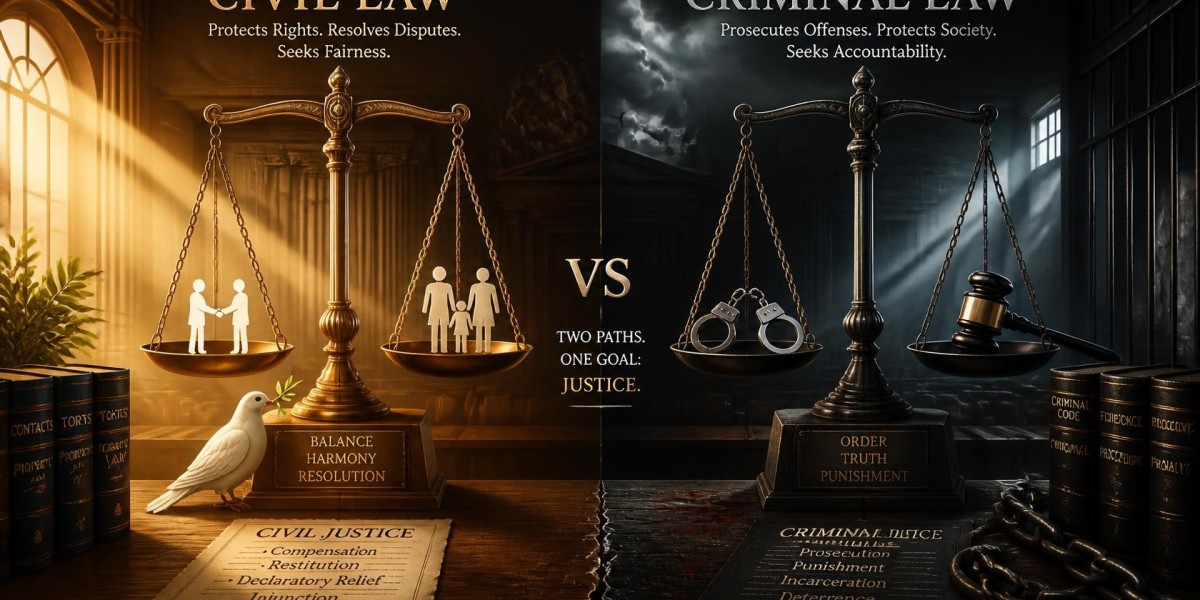

The legal system deals with many different types of disputes and offences, but two major categories are civil and criminal matters. Understanding Civil Law vs Criminal Law is important because the two areas have different purposes, procedures, standards of proof, and possible outcomes. Although the same event can sometimes result in both types of proceedings, each follows its own legal process.
This article focuses on the legal system of England and Wales and explains the main distinctions in straightforward terms.
What Is Civil Law?
Civil law generally deals with disputes between individuals, businesses, organisations, or other parties. These disputes may concern contracts, property, personal injury, debts, negligence, or other legal rights.
The Courts and Tribunals Judiciary explains that civil justice covers disputes where people, businesses, or organisations are seeking to resolve disagreements or protect their rights. Many civil disputes are settled through complaints procedures, negotiation, or mediation without reaching a full trial.
For example, imagine that a customer pays for goods that are never delivered. The customer may have a legal basis to seek compensation or another remedy. Similarly, someone injured because of another person's negligence may bring a civil claim for damages.
Civil proceedings are normally concerned with resolving the dispute and providing an appropriate remedy rather than punishing the defendant.
What Is Criminal Law?
Criminal law concerns conduct that is treated as an offence against the law. Examples can include theft, assault, fraud, and other offences created by legislation or recognised under criminal law.
Criminal proceedings are different from ordinary civil disputes because the prosecution seeks to establish that the defendant committed a criminal offence. In England and Wales, criminal cases begin in the Magistrates' Court, while more serious matters can proceed to the Crown Court.
The Crown Prosecution Service is responsible for prosecuting criminal cases in England and Wales. Its role includes reviewing cases and presenting prosecutions in court, while criminal courts ultimately determine whether a defendant is guilty.
The Main Difference in Purpose
One of the clearest distinctions in Civil Law vs Criminal Law is the purpose behind the proceedings.
A civil case is generally concerned with resolving a legal dispute and determining what remedy, if any, should be provided. A successful claimant might receive financial damages, an injunction, or another court order depending on the circumstances.
A criminal case, on the other hand, determines whether a person has committed an offence and, where there is a conviction, what sentence should follow. Sentencing can involve measures such as imprisonment, fines, or other legally available penalties, depending on the offence and circumstances.
Therefore, while both areas involve courts and legal arguments, their objectives are not identical.
Who Brings the Case?
Another important difference concerns the parties involved.
In a civil claim, the person or organisation bringing the case is generally known as the claimant, while the party responding to the claim is known as the defendant. Civil cases can involve individuals, businesses, landlords, insurers, organisations, or other legal entities.
In a criminal case, the prosecution brings the case against the defendant. The prosecution represents the public interest in enforcing criminal law rather than acting as a private individual seeking compensation.
This difference can affect the way evidence is presented, the responsibilities of the parties, and the possible outcome.
Different Standards of Proof
The burden and standard of proof are particularly important when comparing the two areas of law.
In criminal proceedings, the court must be sure that the defendant is guilty before returning a guilty verdict. The CPS explains that this is sometimes described as proving guilt “beyond a reasonable doubt” or satisfying the court so that it is sure.
Civil proceedings generally use the balance of probabilities standard. In practical terms, the court considers whether something is more likely than not to have occurred. Government guidance describes this as the civil standard and distinguishes it from the higher criminal standard.
This difference is significant because a court may reach different conclusions in separate civil and criminal proceedings involving related facts.
Which Courts Hear These Cases?
Civil and criminal cases generally follow different court routes.
Most civil cases that proceed to court are handled by the County Court, while more substantial or complex matters may be dealt with by the High Court.
Criminal cases start in the Magistrates' Court. More serious criminal matters may be sent to the Crown Court, where trials can involve a judge and jury. The Criminal Procedure Rules provide the framework for criminal proceedings in the Magistrates' Courts, Crown Court, and relevant appellate courts.
The court involved therefore depends heavily on the type and seriousness of the legal matter.
Possible Outcomes in Civil Cases
Civil cases can result in several different remedies. Financial compensation, often referred to as damages, is one of the most familiar outcomes. A court may also make an injunction or declaration where appropriate.
For instance, a person who successfully establishes a personal injury claim may receive damages for losses arising from the injury. In another dispute, a court could order a party to stop particular conduct or comply with a legal obligation.
The precise remedy depends on the nature of the claim and the circumstances of the case. Civil judges normally determine the appropriate remedy after considering the evidence and legal issues.
Possible Outcomes in Criminal Cases
Criminal proceedings have different potential outcomes. If the prosecution fails to establish guilt to the required standard, the defendant may be found not guilty.
If the defendant is convicted, the court moves to sentencing. The sentence depends on factors such as the offence, relevant legislation, sentencing guidelines, and circumstances of the case. The CPS notes that judges and magistrates sentence convicted defendants in accordance with the applicable sentencing framework.
The consequences can therefore be significantly different from those normally associated with civil proceedings.
Can One Incident Lead to Both Types of Case?
Yes. A single incident can sometimes create both civil and criminal consequences.
For example, an assault may result in a criminal prosecution if the relevant criminal offence can be established. Separately, the injured person may potentially bring a civil claim seeking compensation for losses or injuries.
The two proceedings have different purposes and standards of proof. A criminal court deciding whether an offence has been proved does not simply determine every possible civil consequence arising from the same incident.
This is one reason understanding the distinction between the two areas is important.
Why the Difference Matters
Knowing the distinction between civil and criminal proceedings can make legal terminology easier to understand. Words such as claimant, defendant, prosecution, damages, conviction, acquittal, injunction, and sentence have different roles within the legal process.
It also helps explain why two cases involving similar facts may have different procedures or outcomes. A civil court may focus on compensation or another remedy, while a criminal court focuses on whether an offence has been proved and, if so, the appropriate sentence.
The exact rules can vary depending on the circumstances and the specific area of law, so anyone involved in an actual dispute or criminal investigation should consider obtaining appropriate legal advice.
Conclusion
Civil and criminal law serve different functions within the legal system of England and Wales. Civil proceedings primarily address disputes and legal rights between parties, with remedies such as damages or injunctions potentially available. Criminal proceedings concern alleged offences and can lead to conviction and sentencing where guilt is established.
The key differences include who brings the case, the purpose of the proceedings, the standard of proof, the courts involved, and the possible outcomes. Understanding these distinctions provides a useful foundation for anyone studying law or trying to understand how different types of legal proceedings operate.