
Artificial intelligence systems have traditionally been designed to work with one primary type of information at a time. Text-based systems process written language, computer vision models interpret images, and speech technologies analyze audio. Modern organizations, however, increasingly work with information that combines all of these formats. A customer support interaction may contain a written message, a product photograph, a voice recording, and a video. Processing each format separately can make it difficult to understand the complete context.
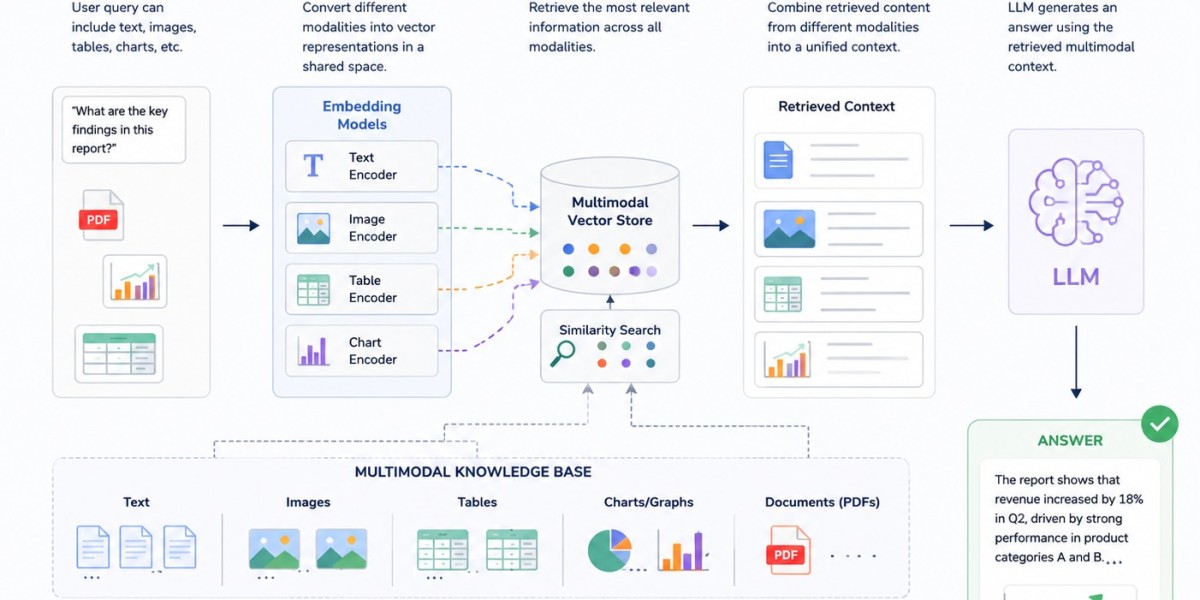
Multimodal Retrieval-Augmented Generation (RAG) addresses this challenge by allowing AI systems to retrieve and use information from multiple data modalities before generating a response. Instead of relying only on a language model's existing knowledge, a multimodal RAG architecture can search relevant text, images, audio, and video and combine evidence from these sources.
For businesses exploring AI-powered customer experiences, this approach can be particularly valuable. Organizations interested in building intelligent conversational systems can explore AI chatbot development services as one way to incorporate advanced retrieval and conversational capabilities into customer-facing applications.
What Is Multimodal RAG?
Multimodal RAG is an extension of Retrieval-Augmented Generation that enables AI systems to retrieve and reason over information represented in multiple formats.
Traditional RAG generally follows a straightforward process:
- A user asks a question.
- The system converts the query into a searchable representation.
- Relevant documents are retrieved.
- Retrieved information is provided to a language model.
- The model generates an answer based on the retrieved context.
Multimodal RAG expands this process. The retrieval layer can work with different types of information, while the generation layer can use the retrieved evidence to produce a response.
For example, imagine a technician asking an AI assistant why a machine stopped working. The relevant evidence might include a maintenance manual in PDF format, a photograph of the damaged component, an audio recording of an unusual machine sound, and a maintenance video.
A multimodal RAG system can potentially connect these sources and produce a more comprehensive response than a system that examines only the written manual.
Why Multimodal RAG Matters for Modern AI Applications
Organizations generate enormous quantities of unstructured data. Not all valuable information exists as plain text.
Businesses may have:
- Product photographs
- Technical diagrams
- Training videos
- Customer support recordings
- Voice messages
- Scanned documents
- Presentations
- Security footage
- Medical images
- Product demonstrations
- Audio interviews
- Charts and visual reports
A text-only RAG system may miss important evidence contained in these formats.
Multimodal RAG makes it possible to treat different forms of information as connected sources of knowledge. This is especially useful when understanding a situation requires more than reading a document.
For example, a product manual might explain how a component should look, while an uploaded image shows how the actual component differs from the expected configuration. Combining both sources creates a richer context for reasoning.
How Multimodal RAG Processes Different Data Types
The core challenge in multimodal RAG is transforming different types of data into representations that an AI system can search, compare, retrieve, and interpret.
The process differs slightly depending on whether the source is text, an image, audio, or video.
Processing Text in Multimodal RAG
Text is generally the most straightforward modality for RAG systems.
Documents can include:
- Web pages
- PDFs
- Word documents
- Product descriptions
- Technical manuals
- Emails
- Knowledge bases
- Reports
- Transcripts
Before retrieval, lengthy documents are typically divided into smaller sections called chunks.
Each chunk is transformed into an embedding, which represents the semantic meaning of the text as a numerical vector. These embeddings can then be stored in a vector database or another retrieval system.
When a user asks a question, the query can also be converted into an embedding. The retrieval system compares the query representation with stored content and identifies information that is semantically relevant.
Example of Text Retrieval
Suppose a customer asks:
"What is the warranty period for this device?"
The system can search a product knowledge base and retrieve the relevant warranty section instead of requiring the language model to generate an answer from memory.
This reduces the risk of unsupported responses and allows the AI system to work with current organizational information.
Processing Images in Multimodal RAG
Images require a different approach because their meaning is represented visually rather than through ordinary words.
A multimodal AI system can analyze images to identify:
- Objects
- Text
- Visual relationships
- Diagrams
- Product components
- Charts
- Spatial information
- Visual anomalies
An image can then be represented through an embedding or combined with a textual description generated by a vision model.
For example, a company might store thousands of product photographs. A customer could upload an image of a damaged component and ask which replacement part is required.
The retrieval system could compare the visual characteristics of the uploaded image against images and product records in the company's knowledge base.
Image-Text Connections
One of the most powerful capabilities of multimodal retrieval is connecting visual and textual information.
A technical diagram might be associated with a written explanation. A product image could be linked to specifications. A photograph could correspond to a service report.
This allows the system to retrieve evidence based on either visual or textual meaning.
Processing Audio in Multimodal RAG
Audio introduces another layer of complexity.
Speech recordings may contain valuable information such as:
- Customer conversations
- Interviews
- Meetings
- Lectures
- Voice notes
- Support calls
- Training sessions
A common workflow begins with automatic speech recognition (ASR). The audio is converted into a transcript that can be searched like text.
However, sophisticated multimodal systems can preserve additional information such as timestamps, speakers, tone-related signals, or acoustic characteristics when those details are relevant to the application.
Example: Customer Support Calls
Imagine a company has thousands of recorded support calls. A customer asks:
"Did we already discuss the installation problem?"
A multimodal RAG system could search call transcripts, retrieve relevant sections, and provide timestamps pointing to the discussion.
This can be significantly more useful than manually reviewing long recordings.
Processing Video in Multimodal RAG
Video is arguably the most complex modality because it contains multiple information streams simultaneously.
A video can include:
- Visual frames
- Spoken dialogue
- On-screen text
- Sound effects
- Presentations
- Demonstrations
- Metadata
- Temporal sequences
A practical multimodal RAG pipeline may divide a video into meaningful segments.
The system can extract:
- Audio transcripts
- Representative video frames
- On-screen text
- Visual descriptions
- Timestamps
- Metadata
These elements can then be indexed for retrieval.
Why Time Matters in Video Retrieval
Unlike a static document, video has a temporal dimension.
Suppose an employee asks:
"Where does the training video demonstrate how to replace the filter?"
A useful system should not merely return the entire video. It should identify the relevant segment and potentially provide the approximate timestamp.
This makes temporal retrieval an important component of video-based RAG.
The Multimodal RAG Pipeline
A multimodal RAG system generally contains several stages.
1. Data Collection
The first step is gathering information from different sources.
An organization might collect:
- Documents
- Images
- Audio recordings
- Videos
- Web content
- Internal databases
The quality of the final AI response depends heavily on the quality and relevance of these sources.
2. Data Preprocessing
Raw data often needs to be transformed before it can be indexed.
For text, this may involve cleaning and chunking.
For images, the system may generate embeddings or visual descriptions.
For audio, speech recognition can produce searchable transcripts.
For video, the system may combine frame extraction, speech transcription, OCR, and metadata processing.
3. Embedding Generation
Embeddings convert information into numerical representations that capture semantic relationships.
Depending on the architecture, different modalities may use specialized embedding models or a shared multimodal embedding space.
A shared representation can make it possible to compare information across formats.
For example, a text query describing a damaged component could potentially retrieve visually similar product images.
4. Multimodal Indexing
The resulting representations are stored in a retrieval infrastructure.
This can involve:
- Vector databases
- Search engines
- Metadata stores
- Document databases
- Object storage
Good indexing should preserve relationships between different modalities.
An image should not become disconnected from the product record it represents. Likewise, a video segment should remain connected to its transcript and timestamp.
5. Query Understanding
When a user submits a question, the system determines what kind of information is required.
A question such as:
"Show me how this component is installed and explain the safety requirements."
may require both visual and textual retrieval.
The system could retrieve an installation video and the relevant safety documentation.
6. Retrieval
The retrieval system searches the available knowledge sources and selects relevant evidence.
This may involve hybrid retrieval, combining semantic vector search with keyword, metadata, or traditional search methods.
The goal is not simply to retrieve the largest amount of information. It is to retrieve the most relevant evidence.
7. Context Assembly
Retrieved information must be organized before it is passed to the generation model.
The system may combine:
- Relevant text passages
- Image representations
- Video segments
- Audio transcripts
- Metadata
- Source references
This creates a multimodal context for the model.
8. Response Generation
The final AI model uses the retrieved context to generate a response.
Depending on the application, the output may be:
- Text
- A summary
- A visual explanation
- A recommendation
- A conversational answer
- A link to a video segment
- A structured report
The key principle remains the same: the response should be grounded in retrieved evidence rather than generated solely from model memory.
How Multimodal RAG Differs From Traditional RAG
Traditional RAG is highly effective for text-heavy knowledge bases, but multimodal RAG expands the range of information that can be retrieved.
| Traditional RAG | Multimodal RAG |
|---|---|
| Primarily text-based | Handles multiple modalities |
| Retrieves text passages | Retrieves text, images, audio, and video |
| Text embeddings are central | Multiple or shared representations may be used |
| Easier preprocessing | More complex preprocessing |
| Limited visual context | Can incorporate visual evidence |
| Audio usually requires transcription | Can preserve audio-related information |
| Video is difficult to represent | Can retrieve specific video segments |
The additional complexity can provide significant benefits when an organization's most valuable information is not purely textual.
Key Benefits of Multimodal RAG
Better Contextual Understanding
A system that can examine multiple forms of evidence can potentially understand situations more completely.
For example, an insurance application could combine a written claim, photographs of property damage, inspection notes, and recorded conversations.
More Accurate Information Retrieval
Different modalities can provide supporting evidence for the same conclusion.
A text description may identify a product, while an image confirms its physical appearance.
Better Customer Experiences
Customers increasingly expect conversational interfaces to understand the information they provide.
A multimodal assistant can potentially handle questions involving screenshots, documents, photographs, and voice messages rather than forcing customers to convert everything into text.
Greater Value From Existing Data
Organizations often possess large archives of videos, images, recordings, and documents that are difficult to search manually.
Multimodal RAG can make this information more discoverable.
Challenges of Multimodal RAG
Despite its advantages, multimodal RAG is not a simple plug-and-play technology.
Data Quality
Poor transcripts, blurry images, incomplete metadata, and badly structured documents can reduce retrieval quality.
Better retrieval begins with better data.
Computational Requirements
Processing images, audio, and video can require more computing resources than processing text alone.
Organizations should consider storage, inference costs, processing time, and scaling requirements.
Retrieval Accuracy
The system must identify the correct evidence from potentially enormous datasets. Poor retrieval can lead to irrelevant context and weaker responses.
Cross-Modal Alignment
Connecting a video segment to its transcript, an image to its product record, or a diagram to its technical explanation requires careful data modeling.
Hallucinations
RAG can reduce unsupported generation, but it does not eliminate hallucinations entirely.
The generation model can still misunderstand retrieved evidence. Therefore, grounding, citations, source tracking, and human evaluation remain important.
Best Practices for Building Multimodal RAG Systems
Organizations can improve reliability by following several practical principles.
Start With a Specific Use Case
Rather than building a general multimodal AI system immediately, identify one measurable problem.
Examples include:
- Searching technical videos
- Analyzing customer support calls
- Finding product information from images
- Searching internal documents and diagrams
- Answering questions about training materials
Preserve Metadata
Metadata such as timestamps, document IDs, product IDs, speaker labels, and source locations can dramatically improve retrieval.
Use Hybrid Retrieval
Combining semantic search with keyword and metadata filtering can improve precision, especially for technical terminology, model numbers, and product codes.
Evaluate Retrieval Separately
Do not evaluate only the final AI answer.
Measure whether the system retrieved the correct information in the first place. A generation model cannot reliably answer a question if the retrieval layer provides irrelevant evidence.
Keep Source References
Whenever possible, the system should preserve links to the original document, image, audio segment, or video timestamp.
This makes responses easier to verify and improves trust.
Real-World Applications of Multimodal RAG
Multimodal RAG has applications across many industries in the United States.
Healthcare
Systems can potentially combine clinical documentation, medical images, recorded information, and other approved data sources. Because healthcare involves highly sensitive information, privacy, security, regulatory compliance, and professional oversight are essential.
Manufacturing
Technicians can search manuals, equipment photographs, maintenance records, and instructional videos through a single interface.
Retail and E-Commerce
Customers can upload product images and ask questions about compatibility, specifications, or replacement parts.
Education
Students and instructors can search lecture transcripts, textbooks, diagrams, recorded lectures, and educational videos.
Legal Services
Legal teams can potentially connect written documents, scanned exhibits, transcripts, and other case materials, subject to confidentiality and professional requirements.
Customer Service
Support teams can combine chat history, call transcripts, screenshots, product manuals, and troubleshooting videos to provide more complete assistance.
The Future of Multimodal RAG
As AI models become increasingly capable of processing different modalities, multimodal RAG is likely to become an important architecture for enterprise knowledge systems.
The long-term direction is not simply to make AI capable of "seeing" or "hearing." The more important goal is to allow AI systems to retrieve, connect, evaluate, and reason over information regardless of how that information is represented.
A future enterprise assistant might receive a voice question, inspect an uploaded image, retrieve a relevant technical document, identify a matching section in a training video, and provide a concise response with supporting references.
This type of system can transform fragmented organizational information into a more accessible knowledge environment.
Conclusion
Multimodal RAG processes text, images, audio, and video by transforming diverse information into searchable representations, retrieving relevant evidence, combining that evidence into context, and using an AI model to generate a grounded response.
The approach extends traditional RAG beyond text and creates opportunities for more sophisticated AI applications. However, multimodal systems also introduce challenges involving data preprocessing, cross-modal alignment, retrieval quality, computational cost, privacy, and evaluation.
Organizations should therefore focus on practical use cases, high-quality data, strong retrieval pipelines, source traceability, and continuous testing.
The real value of multimodal RAG is not simply its ability to process more data types. Its value lies in connecting different forms of information so that AI systems can understand a situation more completely and deliver responses grounded in relevant evidence