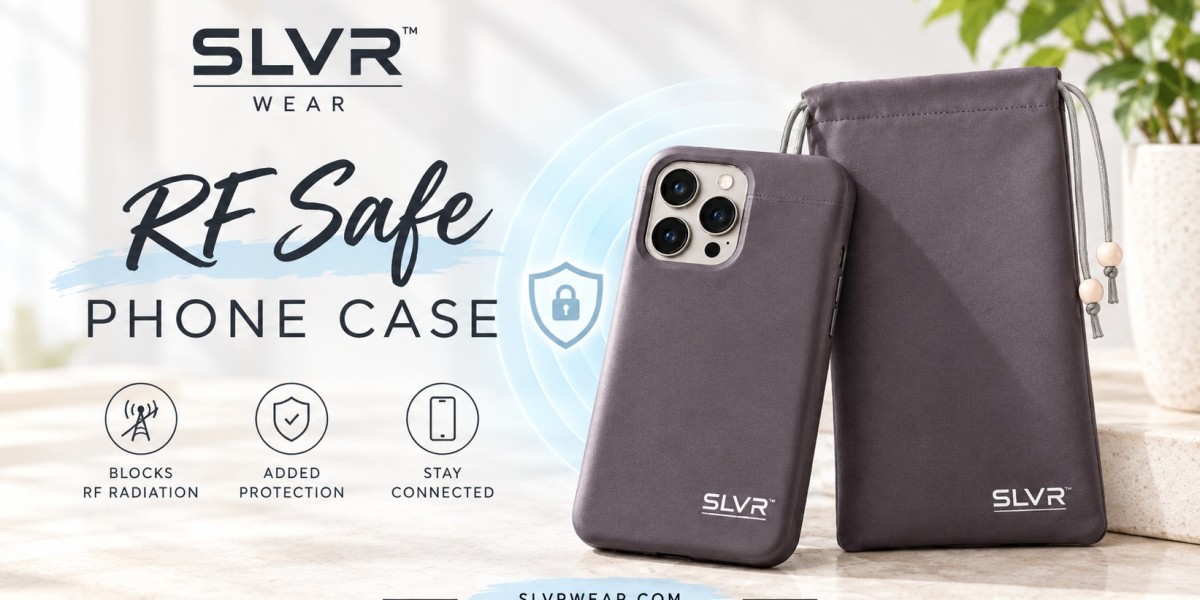

An RF safe phone case is a phone accessory made with conductive, shielding materials that are designed to attenuate radio frequency (RF) signals. Every smartphone is a small radio. It sends and receives signals through cellular networks, WiFi, Bluetooth and GPS; those signals are a form of electromagnetic energy. Many people now look for an rf safe phone case because they want more control over how and when their devices transmit. The term RF safe is shorthand people use online. It does not mean a case makes a phone medically safe or removes all exposure.
It describes a product built around RF shielding technology, which uses conductive fabric or metalcoated material to reduce how much signal passes through. This guide explains how that works and what honest expectations look like. It also covers how to match the right product to your routine. If you are comparing products, it helps to start with a brand that focuses on shielding fabrics. SLVR Wear™ builds RF shielding accessories from silver fiber technology; the sections below explain why that matters.
Understanding Radio Frequency (RF) Basics
Radio frequency energy covers a broad band of the electromagnetic spectrum, from about 3 kilohertz to 300 gigahertz. Radio, television, WiFi routers, baby monitors, microwave ovens and mobile phones all use parts of this range. Cellular networks typically operate between roughly 600 MHz and 6 GHz, while some newer highband networks use much higher frequencies. RF energy is classified as nonionizing radiation. That means it does not carry enough energy to break chemical bonds the way Xrays do. Scientific bodies continue to study longterm questions about everyday RF exposure published guidance and research opinions vary.
Because the conversation is ongoing, many people prefer a precautionary approach. They keep a distance from devices, use speaker mode and choose accessories that give them an option to limit signal when they want to. An rf cell phone case or shielding pouch is one such option. It does not replace commonsense habits, it is not a medical device. It is a practical tool for people who want to manage how and when their phone communicates.
How RF Shielding Works The Faraday Principle
Most RF blocking products rely on the principle named after Michael Faraday, who demonstrated in the 1830s that a conductive enclosure can redirect and absorb electromagnetic fields. When an enclosure is made of conductive material and closed properly, incoming and outgoing signals are reduced significantly at the barrier. This is why elevators and some parking structures can drop your cell reception.
Textiles can do the same job at a smaller scale. Silver is one of the most conductive metals, so silvercoated or silverinfused fibers are woven into fabrics that behave like a flexible shield. A phone sealed inside such a fabric enclosure has its signal path interrupted. This is why a closed cell phone rf blocker pouch can leave a phone unable to connect until it is taken out.
Here is the key detail most buyers miss. A shielding enclosure works because it surrounds the phone and blocks its signals. A thin decorative case that leaves the phone usable and connected does not do this in the same way. If a product lets your phone keep full signal, it is not blocking much. If it blocks the signal fully, you cannot make calls while the phone is enclosed. Honest marketing explains that tradeoff clearly.
Why People Search for RF Safe Phone Cases
People arrive at this topic for different reasons. Some are curious about awareness and want lower signal habits during certain parts of the day. Others work in environments where devices must be isolated, such as privacy conscious professionals or travelers who want to stop tracking and unwanted connections while a phone is stored. Parents often search for an RF protection for cell phones option because children handle devices frequently and they want a storage habit that keeps phones signalfree at bedtime.
Common motivations include
Creating phonefree zones in the bedroom or at the dinner table
Reducing signal activity while a phone is stored in a bag or pocket
Keeping devices disconnected during travel or sensitive meetings
Preserving battery by stopping constant network searching
If a Faradaystyle storage solution suits your routine, a dedicated option like the rf blocker for phones pouch from SLVR Wear™ gives you a simple way to put the phone away without a long list of steps.
Materials Matter Why Silver Fiber Is the Standard
Not every shielding fabric performs equally. Fabrics vary by what metal is used, how it is bonded to the fibers, how dense the weave is and how it holds up with use. Common materials include nickelcopper blends, aluminumcoated films and silvercoated or silverinfused fibers.
Silver stands out for several reasons. It has very high electrical conductivity, which supports effective signal attenuation across a wide range of frequencies. Silver also has natural antimicrobial properties, which is why it appears in medical textiles. Silver fibers can be knit or woven into soft, flexible fabrics that feel more like clothing than hardware, so accessories stay comfortable to handle.
The Silver Scrubs® line from SLVR Wear™ applies that same silverfiber approach to everyday and professional wear. You can see how the brand uses the material in the Silver Scrubs® collection, which shows the fabric technology in a wearable format that goes beyond phone accessories.
What an RF Safe Phone Case Can and Cannot Do
Clear expectations protect you from disappointment; they keep claims honest.
An RF shielding product can reduce the signal that passes through its fabric. It can create a phonefree storage habit. It can help you disconnect on demand and may support a more intentional relationship with your devices. An RF shielding product cannot diagnose, treat or prevent any health condition; it should not be described as doing so. It cannot make a phone work normally at full signal while also blocking that signal.
It also cannot replace professional advice for specific health concerns. If you have questions about RF exposure and health, speak with a qualified professional and consult recognized scientific resources. Using careful language is part of responsible content. Phrases designed to reduce signal,support a lowsignal routine and create a signalfree storage optionare accurate. Phrases that promise health outcomes are not.
How to Use a Shielding Case or Pouch Properly
Even a wellmade product underperforms if it is used incorrectly. A few habits make a real difference. Fold or roll the closure completely according to the product’s instructions so that no gap remains. Make sure the phone sits fully inside with nothing sticking out. Test the product by placing the phone inside, closing the pouch and calling it from another phone. A properly sealed pouch should send the call straight to voicemail or show no connection. Keep the fabric clean and avoid sharp creasing at the closure, which can wear the conductive layer over time. Store the pouch flat when it is not in use to avoid washing methods that the manufacturer does not recommend.
Quick Facts About RF and Phone Shielding
Topic | Fact |
RF range | About 3 kHz to 300 GHz of the electromagnetic spectrum |
Typical cellular range | Roughly 600 MHz to 6 GHz, with some higher bands |
Shielding principle | Based on the Faraday cage effect, first demonstrated in the 1830s |
Shielding fabric metals | Silver, copper, nickel and aluminum blends are common |
Radiation type | RF is nonionizing, unlike Xrays or gamma rays |
Closed pouch result | A properly sealed shielding pouch can leave a phone without a connection |
Partialshield cases | Phone usually keeps its connection, so signal is not fully blocked |
Best use | Storage, travel, bedtime routines and devicefree time |
Everyday Situations Where Shielding Helps
Bedtime is the most common use. Placing a phone in a shielding pouch on a nightstand creates a clear boundary that also stops notifications from interrupting sleep. During focused work or study, the pouch acts as a physical reminder to step away from the screen. Travel is another strong use. A shielded pouch can stop a phone from connecting to networks while it is stored in a bag. Some travelers also use pouches with key fobs and contactless cards to reduce unwanted wireless reads, though results depend on the product design. Families sometimes designate a device basket or a shielding pouch for phones during meals. It is a simple routine that supports conversation without arguments.
Final Thoughts
An SLVR Wear™ RF safe phone case is best understood as a signal management tool. It gives you a clear and simple way to disconnect when you choose, backed by well known shielding principles and conductive materials like silver fiber. Choose a product with transparent claims, test it after purchase and use it as part of broader healthy device habits. Be realistic about what it does and does not do.
Frequently Asked Questions(FAQs)
What is an RF safe phone case?
It is a phone accessory made from conductive shielding material designed to reduce radio frequency signals passing through it. The best known type is a sealed pouch that blocks signals when the phone is inside.
Does an RF safe phone case block all signals?
A properly sealed shielding pouch can significantly attenuate cellular, WiFi, Bluetooth and GPS signals while the phone is inside. A thin case that leaves the phone in use will not block signals fully.
Can I use my phone normally inside a shielding case?
Not if signals are blocked. A fully shielded enclosure prevents calls, messages and data until you remove the phone.
Is silver better than other shielding materials?
Silver has excellent conductivity and flexibility; it is widely used in quality shielding textiles. Performance still depends on weave, construction and how the product is made.
Does an RF safe phone case protect my health?
Shielding products are not medical devices they do not diagnose, treat or prevent health conditions. They are tools for managing signal exposure habits. Consult a qualified professional for health questions.